Global Shifts in Cinematic Archiving Practices Through the Years
Written by Sofia Becker · Jun 7, 2026
Global Shifts in Cinematic Archiving Practices Through the Years
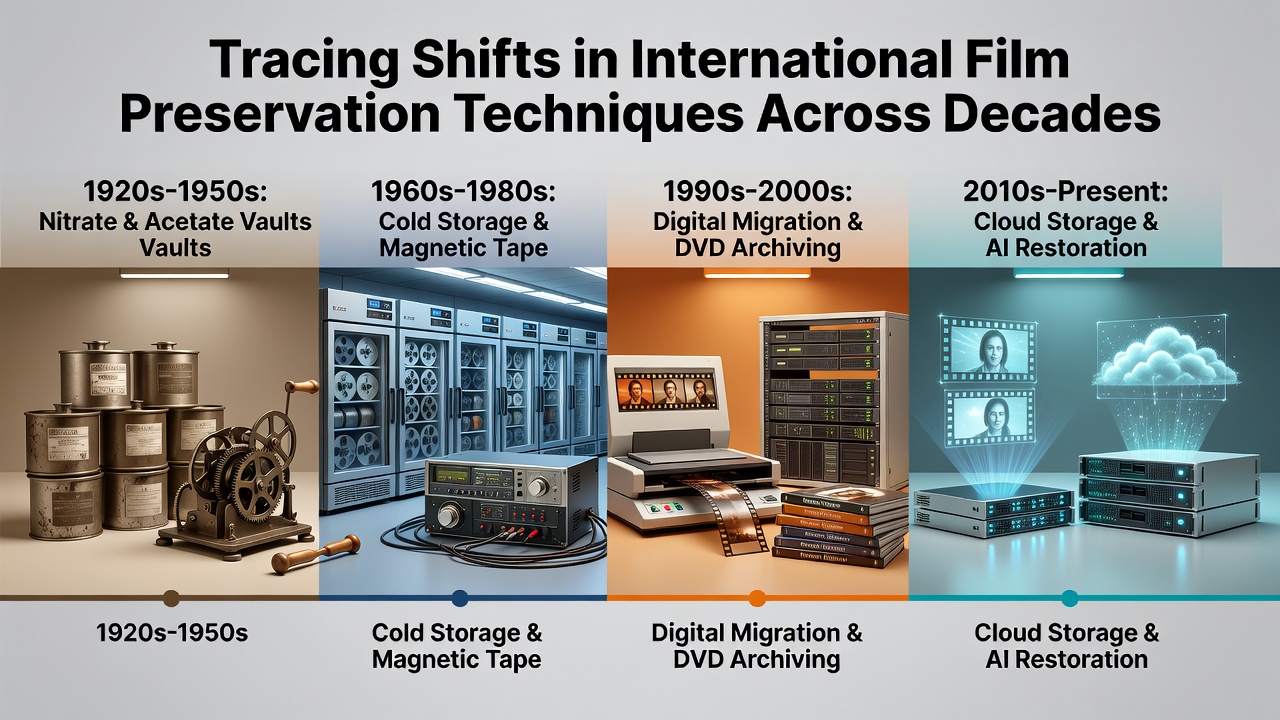
Film preservation has moved through distinct phases as archives worldwide adapted to material limitations, technological advances, and cultural priorities, and researchers have documented these changes in reports from organizations such as the International Federation of Film Archives. Early methods relied on physical inspection and climate-controlled vaults because nitrate stock dominated production until the 1950s, while institutions like the Library of Congress developed manual cleaning protocols that reduced chemical degradation without altering image content.
Nitrate Era Foundations and Regional Adaptations
Archivists in the 1920s and 1930s focused on separating nitrate reels from ignition sources because spontaneous combustion posed constant risks, and European collections in France and Germany introduced fireproof cabinets that later influenced standards adopted in North America. Data from the 1938 FIAF founding documents show that initial member institutions prioritized duplication onto safety stock, although transfer quality varied until consistent laboratory techniques emerged after World War II. Observers note that Asian archives, including those in Japan, combined traditional paper-based cataloging with these physical methods, creating hybrid systems that tracked both film condition and cultural context.
Acetate Transition and Color Stability Challenges
By the 1950s most studios shifted to acetate bases, yet archivists discovered vinegar syndrome caused shrinkage and buckling within decades, prompting the development of cold storage protocols tested at facilities in Australia and Canada. Studies conducted through the 1970s revealed that color dyes faded at different rates depending on dye chemistry and storage humidity, leading technicians to experiment with low-temperature vaults that slowed chemical reactions without freezing the emulsion. The National Film and Sound Archive of Australia published findings in 1982 that quantified dye loss across multiple film stocks, and these figures guided similar programs established later in South Korea and Brazil.
Digital Capture and Metadata Standards Emerge
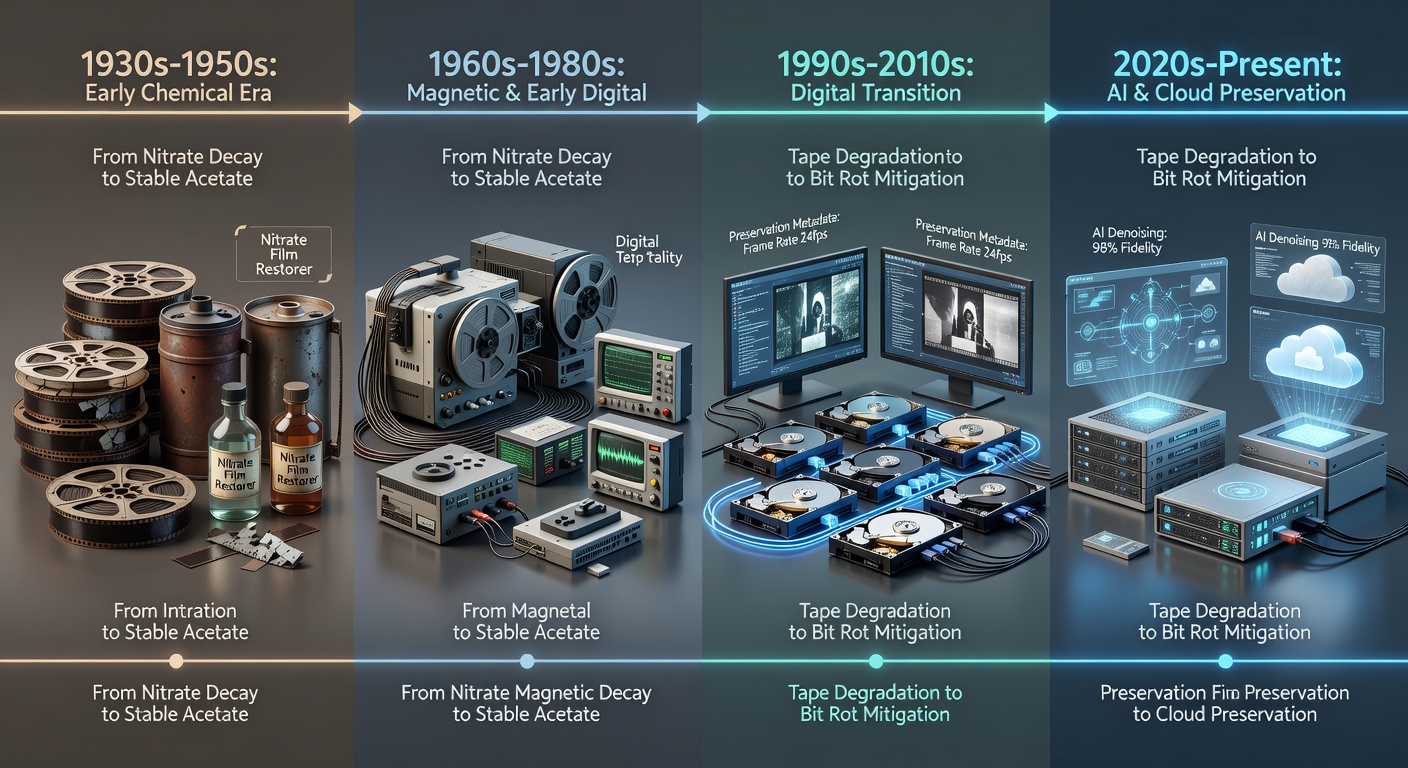
Scanning technology became viable in the late 1990s when resolution reached 4K and higher, allowing archives to create digital surrogates that reduced handling of original elements. European projects coordinated by the Association des Cinémathèques Européennes standardized metadata schemas that recorded both technical specifications and provenance details, while parallel efforts in the United States integrated these schemas into the National Film Preservation Board guidelines. Research indicates that by 2010 over sixty percent of surveyed FIAF members had begun systematic digitization, although budget disparities meant smaller institutions continued prioritizing analog duplication for master elements.
Climate-controlled digital servers replaced some physical vaults during the 2010s, yet experts observed that file format obsolescence required regular migration cycles every five to seven years. Institutions in teh Nordic countries developed open-source tools for integrity checking that later spread to Latin American archives through training programs organized by UNESCO's Memory of the World initiative.
Contemporary Practices and June 2026 Developments
Artificial intelligence now assists with defect detection during scanning, and pilot programs at the National Archives of Japan have reported reduced manual review time by forty percent since 2023. In June 2026 the FIAF congress in Lisbon introduced updated recommendations for sustainable energy use in cold storage facilities, reflecting data collected from thirty member archives that showed measurable reductions in carbon output after LED lighting upgrades and heat-recovery systems were installed. These guidelines emphasize regional adaptation because energy costs and climate conditions differ significantly between tropical and temperate locations.
Collaborative platforms allow smaller collections to share scanning equipment and expertise, and case studies from Eastern Europe demonstrate that pooled resources accelerated digitization of politically sensitive titles that had remained inaccessible for decades. Observers note that such partnerships also preserve linguistic and cultural context during metadata creation, ensuring future researchers can interpret regional production histories accurately.
Persistent Challenges Across Regions
Funding gaps remain the primary constraint, with surveys from the Canadian Association of Moving Image Archivists indicating that nearly half of responding institutions lack dedicated digital preservation budgets. Meanwhile, increasing extreme weather events have prompted reevaluation of vault construction standards in coastal areas, and architects now incorporate flood barriers tested first at facilities in the Netherlands. These adaptations build on earlier lessons while addressing new variables introduced by changing environmental conditions.
Conclusion
International film preservation continues to evolve as archives integrate new tools with established conservation principles, and coordinated efforts through FIAF and UNESCO maintain consistent quality benchmarks across diverse regions. The progression from nitrate handling to digital migration reflects both technological capability and sustained institutional commitment to safeguarding moving image heritage for subsequent generations.